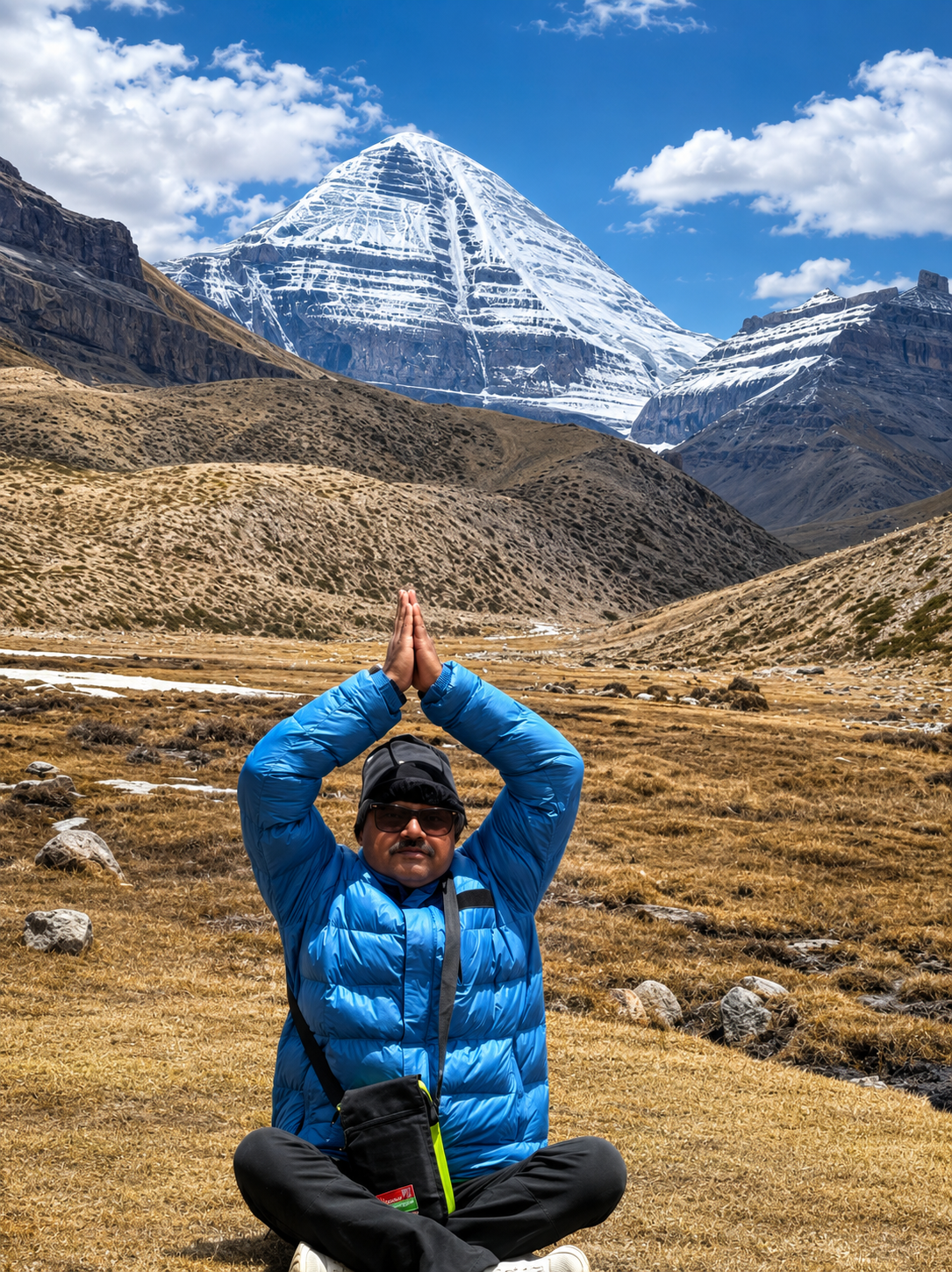
Kailash: Part 1, The Emotional and Psychological Journey
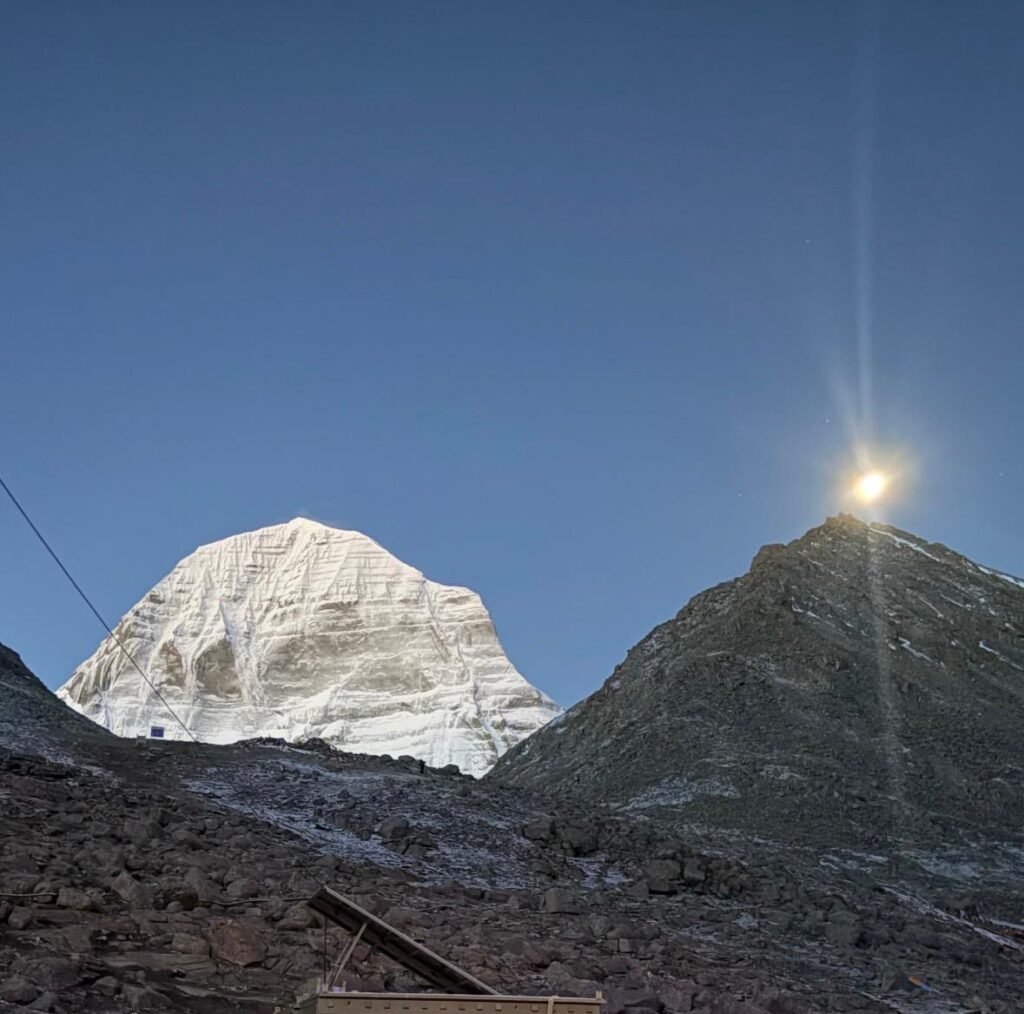
5:30 in the morning.
At 17,000 feet, with the temperature well below freezing, the world seemed suspended between darkness and dawn. A sliver of moon hung low in the western sky, its pale light barely piercing the Himalayan night.
Before me stood two barren mountains, dark and silent, like colossal sentinels. They framed the horizon perfectly, as though they had parted in the middle to create a window.
And through that window, I saw it.
Oblivious to everything else, I stood transfixed.
There, bathed in the first faint light of day, rose a giant silver-shimmering marvel—the majestic Kailash.
Its snow-clad face glowed with an otherworldly radiance, untouched, serene, and impossibly beautiful. It seemed less a mountain and more a presence; less a geological formation and more an idea that had taken physical form.
For centuries, pilgrims, saints, wanderers, and seekers have stood where I stood, gazing upon the same sight with the same mixture of awe, humility, and disbelief.
This was no ordinary peak. This was Kailash.
The abode of Lord Shiva.
And in that moment, standing amidst the silence of the high Himalayas, with the cold biting through every layer and the wind whispering across the barren slopes, I understood why people travel thousands of miles and endure immense hardship for a fleeting glimpse of this mountain.
Some sights are seen by the eyes.
Others are experienced by the soul.
Kailash belongs to the latter.
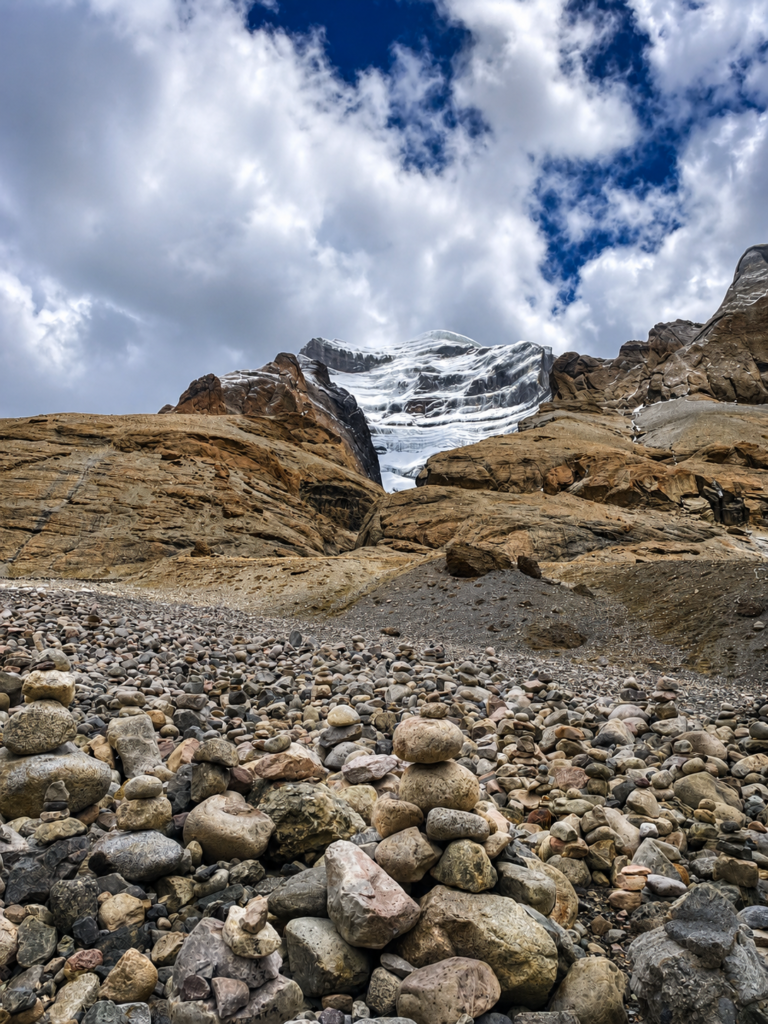
Beyond the sheer physical magnificence of its presence, Kailash embodies something far greater. It is not merely a mountain of rock, ice, and snow. It represents centuries of collective human consciousness, devotion, faith, and longing. For millennia, pilgrims, sages, ascetics, and seekers have looked upon this mountain as the axis between the earthly and the divine. In that sense, Kailash is not just a destination. It is an idea. A symbol. A spiritual inheritance carried across generations.
What is different about Kailash?
There are many mountains in the world that are higher. Everest towers above it. K2 is perhaps more technically demanding and far more dangerous. Human beings have climbed them all. They challenge us to conquer them, to reach their summits, plant our flags, and return with stories of triumph.
Kailash is different.
Kailash does not invite conquest.
It demands surrender.
The journey is physically daunting. The rarefied air, the freezing temperatures, and the relentless terrain test the limits of human endurance. Yet the real challenge begins long before the first step of the parikrama. It begins with a quiet acknowledgment of one’s own insignificance.
Every other mountain asks, “Can you reach my peak?”
Kailash asks, “Can you let go of your need to?”
No pilgrim climbs Kailash. No summit photograph exists. No flag flies from its peak. The mountain remains untouched, serene, and inviolate. One can only walk around it, circling it in reverence, accepting that some things are not meant to be possessed or conquered.
There is profound symbolism in this.
Much of modern life is built upon achievement. We are conditioned to climb higher, earn more, accumulate titles, collect accomplishments, and leave our mark upon the world. Kailash offers a different lesson. Here, the highest act is not ascent but humility. The goal is not to stand above the mountain but to stand before it with folded hands.
The ascent is within.
.
Yet before one can encounter Kailash in the realm of the spirit, one must first earn the right to stand before it.
Our own journey had begun a day earlier at Yam Dwar.
Ponies were in short supply and unavailable to many pilgrims. There were weather warnings of heavy snowfall expected later in the day. Common sense would perhaps have advised caution. Yet common sense alone has never explained why pilgrims have undertaken this journey for centuries. There was something else at work—a force difficult to describe and impossible to measure.
The ancients called it Shiva’s calling.
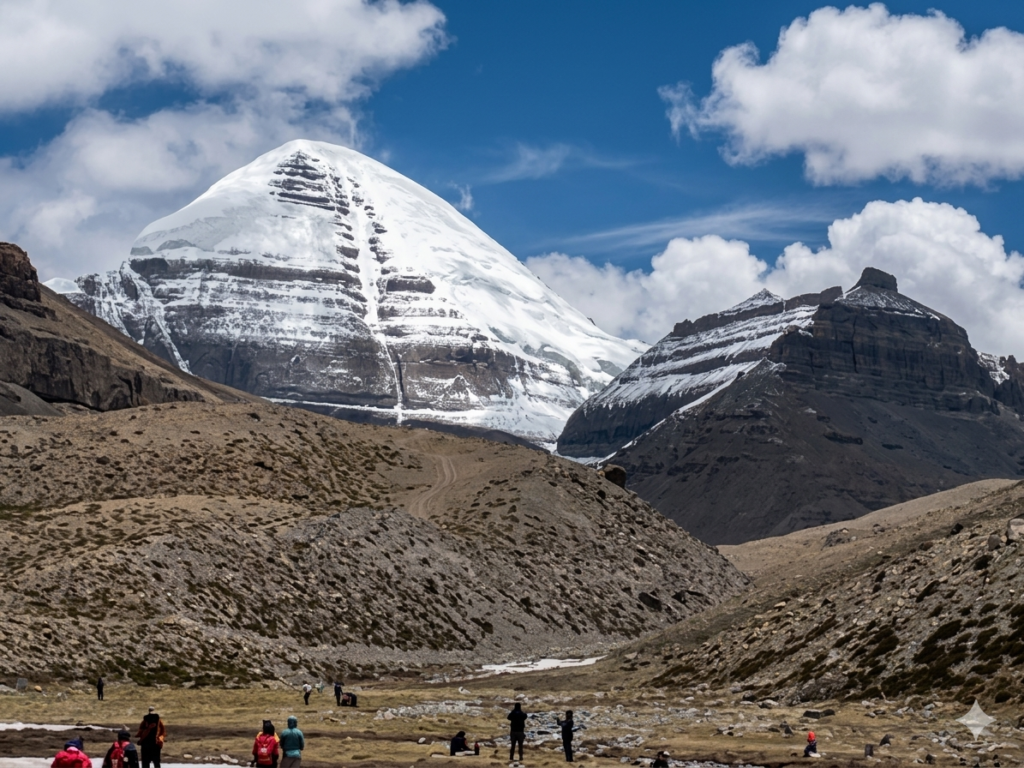
The Limitless Landscape
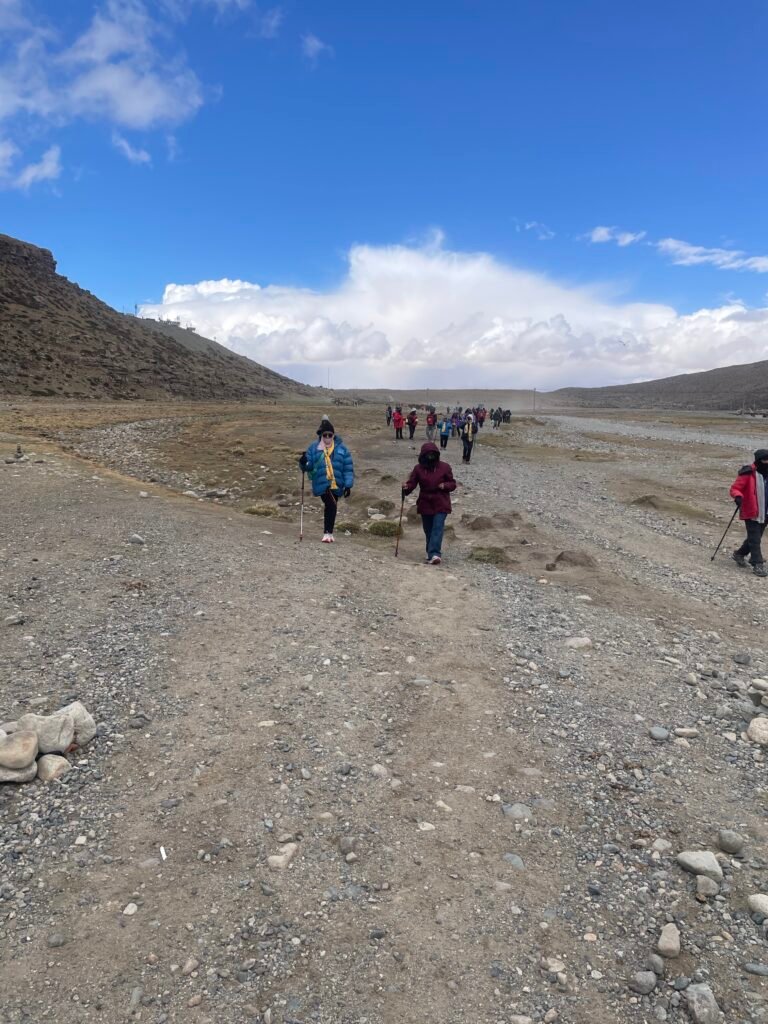
My wife and I set out on foot. Trekking sticks in our hands, backpacks on our shoulders, and determination in our hearts, we began the long ascent. My left knee was protected by a brace, still recovering from a recent meniscus tear. Under ordinary circumstances, I would have considered such a trek unwise. But Kailash has a way of making one reconsider ordinary calculations.
The route stretched for fourteen kilometres, beginning at nearly 15,000 feet and climbing steadily toward 17,000 feet. Every step demanded effort. Oxygen was scarce. Our pulse oximeters stubbornly hovered around the 85 percent mark, reminding us that the body was functioning far outside its comfort zone.
Before leaving Yam Dwar, I paused to bow before the distant South Face of Kailash, visible against the vast Himalayan skyline. It was my first glimpse of the mountain.
A glimpse, and yet somehow a promise.
The trail wound through an immense landscape unlike anything I had encountered before. The horizon seemed endless. There were no forests, no villages, no signs of human habitation. Only barren mountains, sweeping valleys, and a silence so profound that it seemed to possess a sound of its own.
Yet there was nothing lifeless about it.
The starkness possessed a strange beauty. The emptiness felt full. Every turn in the trail revealed another panorama capable of silencing conversation and provoking contemplation.
As the day progressed, the weather began to turn.
The final four kilometres were the most demanding. The gradient steepened, fatigue accumulated, and the predicted snowstorm arrived with full force. Snow lashed against our faces. Visibility diminished. The wind howled across the mountainside with a ferocity that reminded us how vulnerable we truly were.
Around us, the mountain demanded its price.
A few fellow travellers could not withstand the exertion and required emergency evacuation. The sight was sobering. It served as a stark reminder that at these altitudes, determination alone is not always enough.
And yet, remarkably, our spirits remained unbroken.
Not the exhaustion. Not the breathlessness. Not the cold.
Not even the uncertainty of the storm could diminish the sense of purpose that carried us forward.
The body complained. The mind negotiated.
But something deeper kept walking.
Step after step.
Breath after breath.
Toward a mountain that seemed to be drawing us closer with every passing hour.
It was only the following morning, at 5:30 a.m., standing at nearly 17,000 feet between two dark mountain ridges, that I finally understood why.
The tiny moon still lingered in the western sky. The world was silent, frozen, and suspended between night and dawn.
And through a natural window framed by the mountains, I saw Kailash in its full glory.
A giant silver-shimmering marvel rising above the darkness.
Timeless.
Untouched.
Eternal.
Standing before the abode of Shiva, I saw no deity and no idol. There were no temple walls, no priests, no rituals demanding my attention. And yet I was overwhelmed by the unmistakable feeling that I was not alone.
I felt as though the mountain itself was watching.
As the first rays of sunlight touched the snow-clad face of Kailash, the contours of the mountain began to reveal themselves. The ridges, shadows, and curves merged into something strangely familiar. In those ancient lines carved by wind and time, I found myself visualizing the silhouette of Lord Shiva.
Not the fierce destroyer of popular imagination.
Not the mythological warrior.
But the eternal yogi.
Serene.
Detached.
Ageless.
Seated in perfect stillness beyond the turbulence of the world.
At that moment I understood why Shiva is often described not as a god among gods but as a state of consciousness. He represents the stillness that lies beyond desire, the silence beyond noise, the awareness beyond thought. Looking at Kailash, I could almost imagine him seated there in eternal meditation, witnessing the rise and fall of civilizations, the birth and death of stars, and the endless struggles of humankind with a compassion born of complete understanding.
The mountain seemed timeless.
Youthful, yet ancient.
Silent, yet somehow speaking.
Motionless, yet alive.
Standing there, one begins to understand why generations of pilgrims have returned from Kailash transformed. They do not return because they have discovered something new. They return because, for a brief moment, they have remembered something ancient that modern life had made them forget.
The Golden Kailash
As I prepared to leave, I turned one last time toward Kailash.
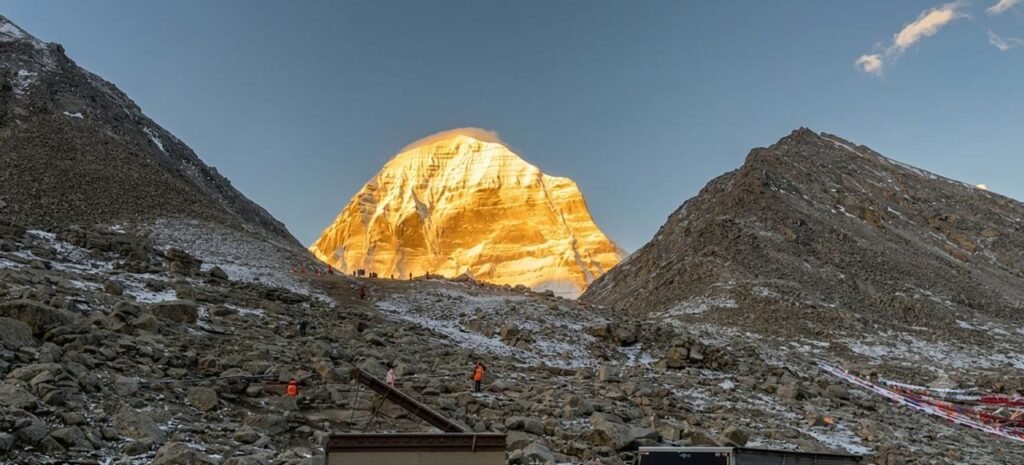
The silver mountain that had greeted me at dawn was slowly changing its form.
The sun had begun its ascent.
The first rays of light touched the summit gently, almost reverentially. For a few moments the transformation was magical. The silver glow deepened, softened, and then gave way to something altogether different.
Kailash turned to gold.
The mountain seemed to awaken from meditation.
The youthful face of Shiva that I had imagined in the contours of the mountain now appeared bathed in celestial light. The barren landscape around it remained cold and silent, yet Kailash itself radiated warmth, majesty, and life.
I stood motionless.
Not wanting the moment to end.
Not wanting to blink.
For a brief instant, time itself appeared irrelevant.
Then, as all moments do, it passed.
The mountain remained.
I moved on.
Perhaps that is the final lesson of Kailash.
We arrive carrying our ambitions, anxieties, certainties, and burdens. We leave with the comforting realization that the mountain needs none of them.
Kailash remains exactly where it has always been—silent, serene, and eternal.
The transformation, if any, occurs not in the mountain but in the pilgrim.
And as I began my descent, carrying memories that would remain with me for the rest of my life, I knew that while I was leaving Kailash behind, a part of Kailash would forever travel with me.
Om Namah Shivaya.


2 Comments
Hari Bhardwaj
Thanks for sharing your spiritual pilgrimage, your words have inspired me to visit the mount Kailash.
Sanjay Banka
That is so well written Dr Shishir. You describe your pilgrimage and your inner feelings in simple yet very powerful words.
Keep up your writings and best wishes for your next travelogue…