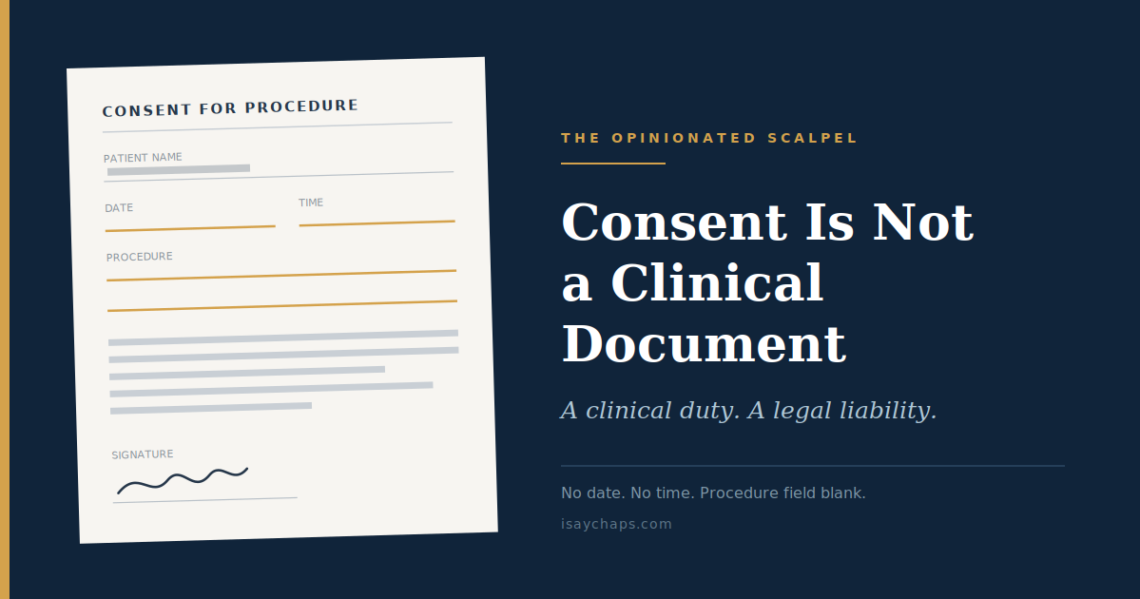
Consent Is Not a Clinical Document
The Opinionated Scalpel — 01
Some time ago I was called to a court as a witness, in a matter concerning my own hospital.
It was my first time. I had spent twenty-five years in medicine by then and had never once stood in a witness box. I arrived early and waited more than three hours. Courts have their own rhythm, and it is nothing like a hospital’s. In a hospital, I am accustomed to dealing with matters of life and death, the usual hustle and bustle that would unnerve an ordinary man. That room was alien. Lawyers moved between benches with a familiarity I could not read. The police stood about with the particular stillness of people who have done this a thousand times. Everybody seemed to understand something I did not.
The judge, when my turn came, was courteous. The questioning was not hostile. And still I found the process deeply unsettling, because the entire exercise proceeded on a premise I had never been trained for: that a document produced in my hospital, months earlier, would now be read aloud, line by line, by someone whose professional purpose was to find what was wrong with it.
Then opposing counsel produced our consent form.
There was no date on it. There was no time. The space for the name of the procedure had been left blank.
I want to be precise about what I felt, because it was not defensiveness. It was recognition. I had run that hospital for years. I had signed off on systems, audits, protocols, registers. And in all that time I had never once looked at a consent form the way a lawyer looks at a consent form.
We were trained for the procedure, not the document
Consider how much of our training goes into the operation itself. Years. Indication, technique, anatomy, complications, post-operative course. We are examined on it, supervised through it, and corrected relentlessly until we get it right.
Now consider how many hours of formal instruction any of us received on the document that makes that operation lawful.
For most Indian clinicians, the honest answer is zero. Consent arrived in our practice as an administrative artefact. It sits in the admission bundle between the billing estimate and the tariff sheet. It is often handed over by a nurse, at a counter, alongside other paperwork, at whatever hour the patient happens to arrive. It is filed. It is retrieved only if something goes wrong.
We treat it as clinical paperwork. It is not clinical paperwork. It is a legal instrument.
It is, in most cases, the only contemporaneous evidence of a conversation that determines whether what we did to a patient’s body was lawful or was a wrong. Every other part of the record — the operative note, the vitals chart, the discharge summary — describes what we did. The consent form is the only document that establishes we were permitted to do it.
That is a categorical difference, and almost nothing in our training prepares us to see it.
What the law actually asks of us
The controlling authority in India is Samira Kohli v. Dr Prabha Manchanda, decided by the Supreme Court in 2008 and reported at (2008) 2 SCC 1. It remains the governing statement of what consent means in Indian medical practice, and it is worth reading in full at least once — it is not a long judgment, and it is written in plain language.
The core of it, for our purposes, is this. Consent is not the signature. Consent is the patient’s informed agreement, given after being told the nature of the procedure, its purpose, the material risks that attach to it, and the alternatives available, including the risk of not doing it. A signature is the record of that agreement. It is not the agreement itself, and where the two come apart, it is the agreement the court is interested in.
The Medical Council of India’s Code of Ethics Regulations, 2002 — which remain operative, having been adopted by the National Medical Commission by notification dated 23 August 2023 — carry the same requirement in the language of professional duty rather than tort.
Put together, the standard is not did the patient sign. It is did the patient understand, and can you show that they did.
Read that sentence again with your own hospital’s forms in mind.
The uncomfortable arithmetic
Here is what makes this a liability problem rather than an academic one.
The signature proves that a patient held a pen. It proves nothing about what was said, by whom, in what language, at what hour, or whether the person signing had any real grasp of what was about to happen to them. When a complication occurs — and complications occur to careful doctors — the question that follows is not whether you operated well. It is whether you were entitled to operate at all.
At that point, the burden of showing valid consent sits with the practitioner and the institution. And what we hand over, very often, is a form with a signature on it and gaps everywhere else.
A blank procedure field means there is no document stating what the patient agreed to. A missing time means there is no way to establish that consent preceded the intervention rather than followed it, or that it was taken before sedation rather than after. A missing date means the document cannot be located in the sequence of events at all.
None of these are clinical failures. Every one of them is a legal one. And they are invisible to us precisely because we are looking at the form as clinicians — checking that it is present and signed — rather than as the other side will look at it, which is for what is absent.
This is not an argument about litigation
I want to be careful here, because the moment doctors discuss consent, the conversation collapses into defensive medicine — how do we protect ourselves, how do we avoid being sued.
That is the wrong frame, and it produces bad forms. Consent taken defensively becomes longer, denser, more disclaimer-heavy, and less comprehensible to the patient. It optimises for the court and abandons the person. Which is a strange outcome for a doctrine whose entire purpose is the patient’s autonomy.
The better frame is that these two obligations were never in conflict. A patient who genuinely understood what was going to happen, who had a chance to ask, and whose understanding was recorded properly, is both better served clinically and better documented legally. The comprehension is the point. The record is evidence that it occurred.
We have spent decades treating the record as the obligation and the comprehension as the optional part. It is exactly backwards.
Where this leaves us
I did not come out of that courtroom thinking my hospital was unusual. I came out fairly certain it was not. If a form like that could pass through my systems, in my hospital, with my name on the door, then it is passing through most hospitals in this country every day.
That is not an indictment of Indian doctors. It is a consequence of never having been taught. We weren’t told during training that this piece of paper operates under a different body of rules than the rest of the file, and that those rules have been settled law since 2008.
So that is what this series is going to do. Over the coming months I will work through what Indian law actually requires of us on consent — what Samira Kohli held, what a defective form looks like field by field, what the emergency exception does and does not cover, what Regulation 7.16 requires and why it is so widely misapplied, how to document refusal, and what changes when the Digital Personal Data Protection Act comes into force.
No legal training required to follow it. I have none either. What I have is twenty-five years in practice, one afternoon in a witness box, and a strong conviction that most of us are carrying an exposure we have never been shown how to see.
Consent is not a clinical document. It is a legal one. A clinical duty, and a legal liability.
We should probably start treating it like both.
Next in this series: what the Supreme Court actually said in Samira Kohli — and why an eighteen-year-old judgment governs what you did this morning.


You May Also Like
Your Patient’s WhatsApp Message Is Now a Legal Liability. Did Anyone Tell You?
May 1, 2026
The Consent That Wasn’t Given — And Perhaps Never Fully Can Be
March 29, 2026